
Latest Articles
Is Your Black Friday Sale a Sale or a Strategy?

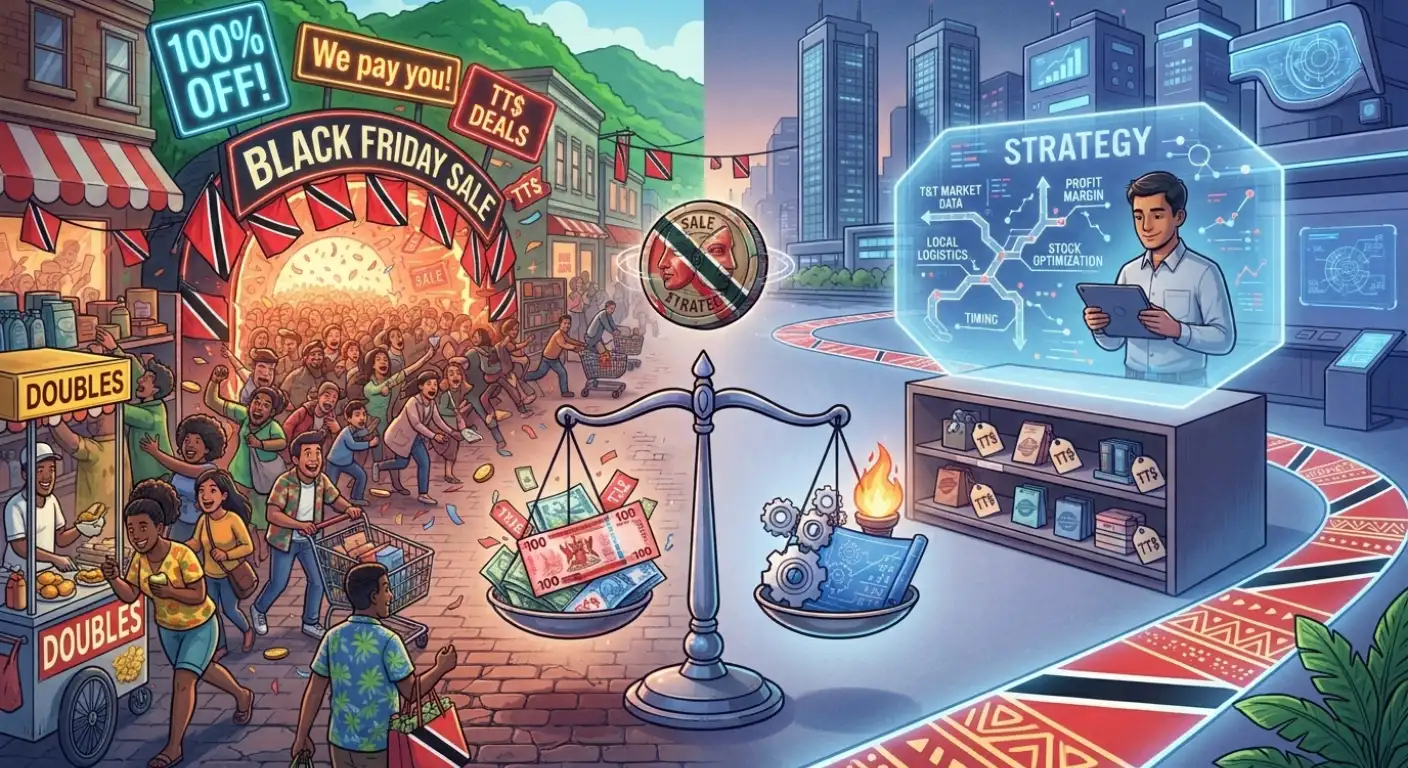
We’re far past ‘when did Black Friday become a thing in T&T’ as it’s now a big ting, forever following the US, so don’t dwell on it. Black Friday shoppers in Trinidad & Tobago know what they want: real bargains, the kind worth lining up for before the doors open… yes, who would have thought Trinis would line up!
With money tight for most households these, and more than 365 days before, they shop hard and compare everything. A weak 10% off gets a ‘yuh cyah be serious? Cut everything by 30% or more, and maybe you’ll draw a crowd, and maybe give away your profit for the month and buss your business…
Most stores, whether they sell from a shop or a website, treat Black Friday as a sale. The ones that get the most out of it treat it as a strategy, and that starts with one question.
What Is Your Sale For?
As a Trini merchant, before you pick a single discount out of the sky like you tend to, decide what you want out of the weekend. Every item in your sale should have a job:
- Clear slow stock. Items that have sat for months are cash stuck on a shelf tying up you money. This is where the deepest cuts belong, even close to cost… a bird in the hand is worth two on the shelf… hard, but necessary.
- Turn stock into cash in one hit. A strong weekend can bring in what would otherwise trickle in over weeks of slow days. That money can pay suppliers or fund your Christmas stock. If you’re lucky you have USD to spend, else you’ll have to buy wholesale locally. A thinner margin is fine here, as long as you know the lowest price you can go.
- Win new customers. This is the long-term play Trinis. The discount is the price of getting someone through your door, or onto your website, for the first time, with the goal of keeping them.
- All of the above. Most stores want a bit of each, and that’s fine. Just give each item one clear job, so you know why it’s on sale and how far to cut. Don’t cut off your nose to spite your face…
The One-Time Shopper Problem
Please get this in your head… many Black Friday customers are not your customers. They came for the deal. Once it’s over, they go back to where they usually shop, and for many of them that’s your competitor. It’s sad, but that’s the reality. It’s very likely you may not see them until next Black Friday.
Meanwhile, every discount comes straight out of your margin. If you normally keep $30 on a $100 item, 20% off leaves you $10, so you need three times the sales just to earn the same. If those extra buyers never come back, you’ve worked harder to make less, and helped your competitor’s customer save some money. This is why you need a plan, and that thing called a strategy.
Your Discounts Are an Advertising Budget
Try looking at your discounts a different way: as money you actually spent.
Let’s do some ‘mats’. Say your store does $60,000 in sales over Black Friday weekend at an average of 25% off. At full price, those same items would have come to $80,000. So you gave away $20,000 in discounts.
For a smaller store doing half that, the numbers scale down the same way. $30,000 in sales at 25% off would have been $40,000 at full price, so that’s $10,000 in discounts.
Whatever the size of your store, that money was a choice. You could have spent it another way, such as a regular social media campaign running for several months, or radio ads leading into Christmas. It’s the same money spent on two different decisions, so judge both the same way: what did you get back for it?
The two work very differently:
- Discounts only cost you when someone buys. If nobody comes, you’ve spent nothing. But they attract bargain hunters, and if you discount every year, some customers learn to wait for the sale instead of buying at full price.
- A campaign costs you upfront, whether it works or not. But it reaches people who aren’t shopping yet, sells at full price, and keeps working after the weekend is over.
Not all of that discount money is a real loss, either. Slow stock that would never have sold at full price was never going to earn its full value. The money to watch is the discount on popular items that would have sold anyway, and you know the Trini feeling like you gave it away.
So set a goal for that money before you spend it: stock cleared, cash raised, new customers whose details you collected, repeat visits in January. If the bigger store’s weekend brings in 150 new customers it can contact again, that’s about $133 each. For the smaller store, 75 new customers works out to the same $133 each. Would a campaign costing the same amount have brought in as many new customers? That’s the comparison to make. These are example figures, you have to run your own numbers.
Run the Numbers Before Friday
For each item in your sale, do yourself a favor and run your numbers:
- The objective of the sale: slow stock, cash, new customers, or a mix.
- What it really costs you, including delivery, card or gateway fees, packaging.
- The sale price, and what you keep.
- How many you need to sell, and whether you have the stock.
If an item has no clear job, or the numbers don’t work, do yourself another favor and leave it out.
Deals That Feel Real Without Blowing Your Margin
- Doorbusters. Offer a handful of deep deals in limited quantity, such as for the first 20 customers or until 10 a.m. These are what people line up for and tell their friends and family about. Count them as advertising, because that’s what they are.
- Bigger cuts where you can afford them. High-margin items can take a deep discount. Thin-margin items stay at full price or get a small one.
- Bundles. Pair a popular item with a slower one at one price. The total saving looks big, and you move more stock in one sale.
- Spend thresholds. “$100 off when you spend $800” feels generous and protects your margin better than 10% off everything.
- Honest “was” prices. Customers notice the very Trini practice of raising a price in advance so it could come down for a fake sale. A fake deal costs you more in trust than it makes in sales. Trinis don’t like to get fooled so, and will make you pay for it.
Turn Deal Hunters Into Regulars
This is where you need to have a the long-term strategy.
- Collect their details. Ask for a WhatsApp number or email at the register. You should have been doing this all year and yet you haven’t, what were you waiting for? And online, every order already gives you one, so ask permission to keep in touch.
- Give them a reason to come back. A voucher that only works in January brings them back during the slowest month of the year. Don’t let them walk away their hands full and you empty-handed.
- Make the first visit count. A quick checkout, helpful staff and delivery that arrives when you promised are what make someone choose you next time. Trinis find good customer service refreshing, and reward it.
- Follow up. A thank-you message the week after, and a heads-up when new stock lands, keep you in mind when they’re ready to buy again. For heaven’s sale, keep in touch. Trini merchants don’t realize the value of email newsletters.
If You Sell Online
Cyber Monday never really caught on in T&T, and that’s because our online stores are a hodge-podge, under-the-radar mix; no stores really stand out, and that’s what’s needed in the market… one or two stores to be known as leaders, and there is none.
Local online stores run their deals in the same Black Friday rush as the malls, so their deals have to be just as strong. Everything above still applies, with a few differences.
- There’s no line at the door. Your doorbusters become “first 50 orders” or “until midnight Friday”. Keep your stock levels accurate, or you’ll sell items you don’t have and spend the next week saying ah sorry!
- Every order carries extra costs. Delivery and payment gateway fees come out of each sale, so a small order at a deep discount can lose you money. A minimum order, or free delivery only above a set amount, protects your margin and raises the average order.
- Your competitor is one tab away. Shoppers compare prices in seconds, so a fake “was” price gets caught fast.
- Your checkout has to hold up. A slow site or a failed payment loses the sale. Some local debit cards don’t work online, so tell customers clearly which ways they can pay. Trinis are very unforgiving when they get online payment issues. In our experience, many times it’s their bank’s security wall protecting their credit card too well, but they don’t want to hear that.
- Delivery is your first impression. Couriers are busy that weekend. Promise delivery times you can keep, because a late first order rarely leads to a second one. Be prepared for our local couriers too, they are Trinis too, remember?
- If you also have a physical store, keep one set of prices. Make the deals match, or say clearly which ones are online only or in store only. And have a strategy for this too, if you want to drive your online sales long term.
- You already have their details. Every order comes with an email address and phone number, so the one-time shopper problem is easier to fix online. Just make sure you actually follow up.
Conclusion
Whether customers walk through your door or come through your checkout page, most of them will look you up online first. You’ll have to hope they’ll look you up directly as for sure you didn’t spend any time on improving your SEO to get found… or did you? A reminder to get on that too.
For the full picture on planning an online store, see our guide to starting an online store in Trinidad & Tobago. If you’d like someone to check your website before the traffic comes, message us for a free Online Store Check.

Get Our Next Guide First
Practical guides for T&T businesses on payments, delivery, ads and websites, sent to your inbox the day they go up. One email per new article. No spam, and you can unsubscribe anytime.
