
Latest Articles
AI Website Builders: What the Reels Don’t Show You

Fire your web designer! Build your own website in minutes with AI! If you have spent any time on Instagram or TikTok recently, you have almost certainly seen such reels. Someone sits in front of a laptop, types a few prompts into an AI tool, and thirty seconds later a fully designed website appears on screen. The claim is consistent: professionals are finished, agencies like us are irrelevant.. everybody dead, and you can have a $10,000 website for the cost of a subscription. Comments fill up with people tagging their friends, saying they are cancelling their web designer.
If we at Forward Multimedia say ‘not so fast!’, you will construe it as a kneejerk , defensive reaction. And how can you blame us, it’s the core of our business. But we also use AI tools every single day. If you’ve followed us for long, you’ll know all our articles are written form a standpoint of objectivity, and this is no different.
We will agree, the reels are not lying. AI has genuinely made it possible for every uncle, tanty, and nennen with no design background to produce something that looks like a website in an afternoon. That is real, and it is remarkable; after all, it looks like a duck and quacks like a duck, so it must be a website, ent? The question is not whether it is possible. The question is what you actually get, and what happens after.
What AI Website Builders Actually Produce
The tools generating all this excitement, platforms like Squarespace, GoDaddy, Wix, Framer, and others, are genuinely impressive at producing clean, modern-looking layouts from a text description. For a personal portfolio, a simple information page or a landing page, they work well. The visual output has improved dramatically.
Hosted AI Builders- Instant Website Publish
What they produce, however, is a website that exists inside a proprietary system; publishing is fully automated. However, you do not get code you own. You do not get a site you can move. You get a subscription-dependent presence that works for as long as you keep paying the platform, built on infrastructure you have no access to and cannot modify beyond what the platform allows.
For many simple use cases, that trade-off is fine. Where it starts to matter is the moment your business needs anything that goes beyond the template, which is more likely for established T&T businesses.
Coding AI Builders
For the do-it-yourselfers, the above Click-to-Publish method would be the simplest form of AI web design. More advanced DIY-ers, have other options to design an AI website that hands you a lot of raw code, which you then connect to a domain to be visible on the web.
There are a number of ways to do so, but for the purpose of this article, we won’t get into it here, as these methods are for the tech-savvy individuals, not uncle and tanty, who the reels ostensibly targets, and who will get giddy when their hear the term ‘html’… and ask what you say: ” haul mih what!”
Disparaging reference of 'AI Slop'
Just like the AI generated graphics you see all over your newsfeed from Trini businesses and content creators, AI designed websites also suffer from that AI look that’s unmistakable, and a disparaging phrase has been coined to describe them called ‘AI Slop’; a term frequently used by web developers and designers to describe generic, uninspired, AI-designed websites.
When applied to web design, “slop” refers to a site generated entirely by an AI coding agent or website builder where a human did not bother to customize the default settings. Because AI models predict patterns based on common training data, these sites look completely identical.
In Trini terms, it’s the result from a lazy thought-process, tantamount to ‘dat good dey!’.
The WordPress Reality in T&T
This is where it becomes especially relevant for businesses in Trinidad & Tobago. Over 75% percent of T&T business websites run on WordPress, and not because it’s your choice of platform, but because it’s the primary platform used by 99% of web companies in the country, including us here at Forward Multimedia. The 1% who don’t use it are not the elite though, quite the opposite; they are smaller web businesses and individuals who use builders like Wix, GoDaddy and Squarespace because they lack WordPress expertise.
WordPress is open source, portable, endlessly customizable and powers everything from small business brochure sites to large e-commerce operations with thousands of products. It runs WooCommerce, which is how most T&T online stores process payments through local gateways like WiPay, Powertranz, Scotiabank eCom+, and local courier integration like CSF and Odeliver. It connects to local booking systems, inventory systems (like POS systems like Lightspeed, Epicor, for example), and CRM platforms (like Zoho). If your web designer gets hit by a PTSC bus, heaven forbid, another person or web agency can easily take up and continue with your website.
The Truth about AI Tools
No prompt-to-website AI tool gives you a properly configured WordPress installation. Not one. What you get from those tools is a closed platform that superficially looks similar but operates on completely different foundations. Some might actually provide you with your own CMS (content management system), just like WordPress, from which to manage your website, but that would be reinventing the wheel, wouldn’t it?
A proper WordPress site requires: a hosting environment configured for performance, domain and DNS setup, SSL certificate installation, a carefully selected and configured set of plugins, a security hardening process, a backup system, and for WooCommerce stores, payment gateway integration, shipping configuration, tax settings and product management. Each of those is a technical decision with real consequences. None of them appear in the reel.
The Technical Reality Missing from the Reel
There is a gap between the superficial comparison of “a website exists” and “a website works for your business” that becomes most visible, and what Trini business owners contemplating there own AI website, should also be contemplating.
Code Quality & Framework
Forward Multimedia’s own full-stack developer has confirmed that AI generated code, though absolutely useful, and which most every developer uses now, has to be reviewed and mixed with own code. As it’s prompt engineering, you always have to review the AI code code and continuously rewrite until you get what you want. Just letting the AI code everything blindly with whatever tech stack, design principles etc. it chooses is bad practice.
Speed & Performance
Google ranks faster websites higher, and users leave slow websites within seconds. AI-generated sites frequently produce bloated code and unoptimized images because the tool is generating for appearance, not performance. Core Web Vitals, Google’s framework for measuring real-world page experience, requires specific technical attention that goes well beyond choosing a template. A site that scores poorly on Core Web Vitals will rank poorly, full stop.
Now, you may have noticed some AI sites are actually very fast, and that’s because the entire site is on a single page; that’s how AI coded it. When you click menu links, you are actually jumping back and forth between sections of the same page. This is not good practice because if anything breaks on the site, the entire website will go down. If you’re doing it yourself, you won’t know this.
Security
This is a real problem in T&T and has been on the rise this year. WordPress sites that are not actively maintained are among the most frequently hacked properties on the internet. Outdated plugins, weak passwords and unpatched themes are all that a bot needs. Security is not a one-time setup. It is ongoing monitoring, regular updates, firewall configuration and, when something goes wrong, the ability to restore from a clean backup. The DIY builder who set up their site with an AI prompt in February is usually not thinking about this in November when the site gets compromised.
If this happens, there’s no one to call, it will be your headache. You already have enough headaches wondering if your cashier will show up tomorrow and if your bank will give you that USD to pay your foreign suppliers. And that’s just two headaches from a very long list… even our head huttin’.
SEO
Trini businesses want to get found, and this is among one of the positive things we’ve noticed in the market this year. There is a common misunderstanding that search engine optimization is simply about writing good content. Content matters, but the technical layer matters just as much. Schema markup, proper heading structure, meta title and description configuration, canonical tags, XML sitemaps, robots.txt settings, page speed, mobile responsiveness and internal linking architecture are all components of technical SEO. A site can be on the internet for three years and rank for nothing because the technical foundation was never properly set up.
For T&T businesses specifically, local SEO configuration, Google Business Profile integration and Caribbean-specific search behavior require deliberate, knowledgeable attention.
Ongoing Maintenance
Ongoing maintenance. WordPress core updates, theme updates and plugin updates release constantly. Running them carelessly can break a site. Not running them leaves it vulnerable. Someone needs to manage this, test after updates, check that forms are still working, verify that checkout processes complete, confirm that third-party integrations have not broken. None of the reels feature the person twelve months later doing maintenance checks bright and early on a Monday morning.
Where AI Genuinely Belongs in Web Development
Here is the part that should settle any doubt about whether we are being defensive: AI tools are excellent, and professionals who are not using them are behind.
At Forward Multimedia, AI assists with content drafting, layout exploration, image generation, copywriting refinement and code suggestions. It accelerates parts of our workflow meaningfully. The tools are good and getting better quickly.
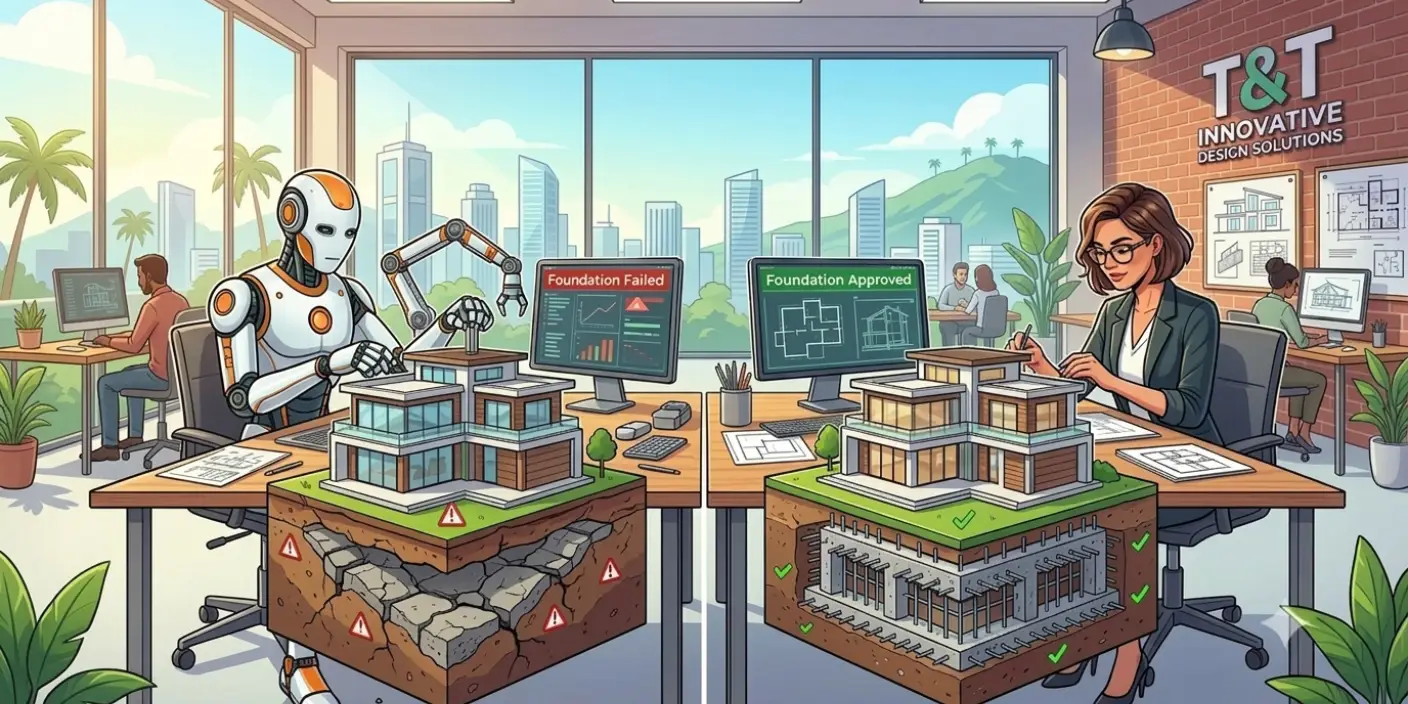
The honest distinction is between AI as a tool in the hands of someone who knows what they are doing, and AI as a complete replacement for the expertise itself. Yes you can cut and join two pieces of PVC pipe, but it doesn’t make you (or me!) a plumber.
For specific use cases, a DIY AI-built site is a perfectly reasonable choice: a personal portfolio with no e-commerce, a simple information site for a micro-business with minimal traffic, a temporary landing page for an event. If the site’s failure would cost you nothing, the risk of building it yourself is low.
For a business that depends on its website to generate enquiries, process orders, rank in search, handle customer data securely and operate reliably around the clock, the risk profile is entirely different.
The Real Cost Calculation
The “$10,000 website for dollars” comparison against $50 USD is not a fair one. A professionally built and maintained website is not a one-time design expense; it is an ongoing business system. The value is not in the visual design alone. It is in the performance optimization, the security infrastructure, the SEO foundation, the WooCommerce configuration that actually processes payments, and the maintenance that keeps all of it working as the business grows and technology changes around it.
When you calculate the true cost of DIY, you have to include: your time learning tools and troubleshooting problems, the annual cost of hosting, domain, premium plugins and security tools, the revenue lost while the site was slow or broken or ranking nowhere, and the cost to fix it properly after the problems compound. Those numbers rarely stay small.
The business that built their own site with an AI tool and saved a few thousand dollars upfront can end up being the same business that calls us some time later with a hacked site, no backups, poor Google rankings and a WooCommerce store that has been quietly abandoning carts for months because the payment gateway was never configured correctly. Which T&T business owner really knows where to go to to get the payment gateway API to provide for AI to integrate with their site?
The Goal Was Never the Website
The reels measure success by the appearance of a website, which is the wrong metric.
The goal is not to have a website. The goal is to grow your business online. Those are not the same thing, and the gap between them is exactly where technical knowledge, ongoing expertise and professional accountability live. Trini businesses have long woken up to the fact that a mere online presence won’t cut it; the online space in T&T has truly become competitive.
AI has made it easier to produce something that looks like a website. It has not made it easier to build a business online. That still takes strategy, technical skill, ongoing maintenance and the kind of judgment that comes from having done it at scale, across many industries, for many years. This is the experience agencies like us at Forward Multimedia, has under our belt and in our arsenal.
Conclusion
We are not going out of business by any stretch of the imagination. If anything, we feel T&T businesses actually need us more during this major industry disruption. And, we are using these tools ourselves, building better websites faster, and doing work that still requires knowing far more than what fits in a sixty-second reel.
