
Starting E-com Test
How E-Commerce
Works in Trinidad & Tobago – A Concise Guide
At the second half of 2024 the business of E-Commerce is still moving on at a steady clip. Customers are still shopping online, and online stores keep opening. Still, there are no big players that stand out; everyone seems to be staying in their lanes, doing their own thing. It’s not to say that there are no big plans, but the reality of execution is that it requires time, money, patience and expertise… and not necessarily in that order. And lest we forget, were are Trinis, and Trinis to the bone.
A successful E-Commerce venture requires the mechanical elements for the functional aspect which is what is explained below; but that’s just the engine. A truly successful online store requires creativity, savviness and an understanding of how your customer thinks and behaves, and tailoring your website to suit. Of course, that’s easier said than done, and would be the subject a different article.
The Three
Most Important
Moving Parts
There are only three (3) moving parts that matter (obviously there are many moving parts, like a car, for the entire system to work), but essentially, when we shop on Amazon, we basically Browse/Add to Cart (the online store), Checkout (the payment gateway), then wait for our order at our door (delivery).
Online stores in Trinidad & Tobago are running like clockwork, and have been for years. There are no more questions about the whether the moving parts are available. The questions are about the moving parts themselves… what are the options, and advantages of one over the other.
On This Page
The Platforms- Shopping Carts
The platform is the software or engine that runs your online store and everything you need to manage it in the backend (like add products, manage inventory, set prices, process orders etc.), and what your visitors experience in the frontend (the look and feel of the website, browsing categories, adding to cart and payment).
While the front end is about aesthetics and usability, the back end ensures smooth operations and data integrity, working behind the scenes to keep the e-commerce platform running seamlessly. Understanding the distinction between these two components is crucial for anyone involved in the development and management of an e-commerce website.
There are five (5) options currently available in Trinidad & Tobago.
1. Open-Source Content Management Systems (CMS)
Years ago when CMS platforms started gaining popularity, names like WordPress, Joomla and Drupal were typically mentioned in the same conversation. They were used for regular, information-based corporate websites. Being open-source, features were extended via plug-ins, among them them was shopping cart functionality.
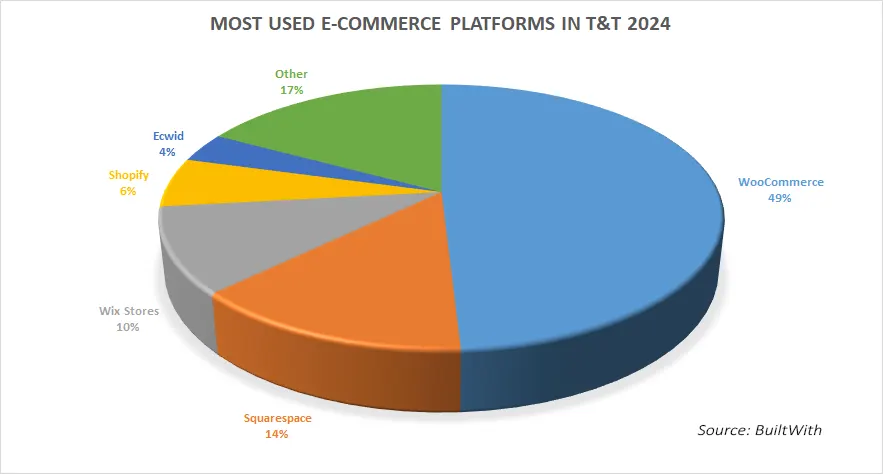
Today, WordPress dominates worldwide for both business websites and online stores. The Woo Commerce plug-in is the shopping cart engine most would be familiar with, and no second place comes to anyone’s mind. Almost half of all online stores in Trinidad & Tobago are powered by Woo Commerce.


Being the number one platform in the country and the planet, it’s also the one we primarily recommend. It ain’t broke, there’s nothing to fix. Any inherent disadvantages and issues, are not unique to the platform. If any other platform or plug-in builds a better mousetrap, then obviously it will be worth a long hard look. Additionally, the pool of experts locally is large. Whatever the reason, it’s very likely you can get someone proficient enough to manage your online store if needed, including yourself.
WordPress is way ahead of the competition as a platform for both regular business websites and online stores and is the platform we use almost exclusively for business websites and we know it well.
2. Open Source E-Commerce Platforms - Magento, Open Cart, Prestashop, etc.
Literally, none of these are even remotely considered as options in T&T today. While they may have inherent value worth considering, every fundamental need is adequately covered by WooCommerce, and none would be compelling except for some unique case.
In its heyday, Magento reigned as the number one E-Commerce platform on the planet, powering about a third of all online stores, and had a good run till it was eclipsed by Woo Commerce. It changed hands a few times with attempts on revival, but none ever took. Current owner is Adobe, which has a free version called Magento Open Source. With the rise in popularity of hosted shopping cart solutions like Shopify and others, it's already low worldwide market share dropped further from 8% in 2024 to less than 5% in 2025.
Open Source platforms for 'DEDICATED E-COMMERCE'
The funny thing is that these platforms were designed for the sole purpose of online shopping. They were not blogging platforms retrofitted with a shopping cart plug-in like WordPress. Conventional wisdom would dictate that by virtue of being built from the ground up for the purpose, they would stand their ground, especially against any 'posers'. But that didn’t happen. Market share for the other ‘designed for E-Commerce’ platforms like Prestashop and Open Cart etc. is now minuscule, a shade of what it was.
Littering the online store landscape in Trinidad & Tobago with many platforms won’t do the local industry any good and would perhaps hurt, as we’ll all (both web designers and merchants alike) be jack-of-all-trades and masters of none.
Fortunately, the local market naturally gravitated to the most popular, and easier to use Woo Commerce platform.
What's the big deal with Open Source?
Open source platforms allow developers to access their code to make custom modifications. The custom modification of interest to us here in T&T is the ability to integrate our payment gateways and delivery modules. Proprietary platforms are usually ‘closed-source’ with no access allowed.
3. Hosted Platforms (Semi-open source) - Fygaro Shops, Shopify, Squarespace, Weebly, Wix
This is attractive to do-it-yourselfers who prefer to pay a monthly fee for an E-Commerce service that they can manage on their own, without having to deal with the technical platform maintenance like that needed for WordPress/WooCommerce. Those that are fully closed source, are obviously non-starters and out of the question. Shopify was one such, but then partially opened; now we can integrate our local payment gateways like Powertranz (First Atlantic Commerce) and Scotiabank eCom+. We can’t yet integrate local delivery. Fygaro Shops come with the convenience of payment integration supported by local banks.
Generally, the back-end customization options on these hosted solutions are not as robust as with WooCommerce, and no large online retail store would consider these, but one can still build a very decent store.
Example of a Shopify Store:
4. E-Commerce-Ready Point of Sale & ERP Systems
This option isn’t new, just generally expensive and not financially feasible for many businesses. Forward Multimedia experimented with workarounds to sync point of sale systems like CounterPoint and Microsoft RMS, and accounting systems like Peachtree, with a WooCommerce. However, while this method was workable, it wasn’t optimal, and in middle of 2022, such a workaround service was permanently discontinued.
An affordable E-Commerce-ready cloud-based Point of Sale system called Lightspeed has been gaining ground in Trinidad & Tobago over the past few years. There’s the option to use the default shopping cart previously known as Ecwid, which was acquired in 2021. What’s particularly exciting is the ability for seamless sync with Woo Commerce and Shopify, and for this reason Forward Multimedia became an official partner.
There are other locally promoted point of sale systems with WooCommerce sync features, namely Loyverse and Odoo. However, they are not native syncs built-in with the POS; the functionality is provided by third parties. We do have a current sync with Loyverse on a client's site since 2025 and monitoring performance. Generally, we do not recommend syncs that depend on third party support, which is why we promote Lightspeed.
If you have a POS or ERP solution, check if they offer any E-Commerce add-on or functionality first.
Example of POS based stores:


The Payment Gateway
So you have your platform, whichever you so choose, and your customers can conveniently browse your online store, view your products, add them to cart and proceed to checkout the way God intended. Trinis don’t have to be schooled on what comes next: enter billing, delivery address then proceed to credit/debit card number which will securely collect the funds from Visa/MC etc., (for a transaction fee of course) and forward the funds for you— after all, it’s your sale.
Payment gateways are of two (2) types:
- Merchant Account- like First Atlantic Commerce (FAC) & Scotiabank eCom+
- Aggregators- like Wipay & PayWise
Powertranz (Formerly First Atlantic Commerce) Payment gateway via a local bank
From my previous articles you are very aware of this gateway provided by First Atlantic Commerce out of Bermuda through partnerships with most all banks in T&T:
- First Citizens Bank

- Republic Bank
- Scotiabank
- RBC Royal Bank
- Canadian Imperial Bank of Commerce (CIBC)

I’ve done integrations with all of the above except Scotiabank. I have no preference of one bank over the other these days as rates vary and is pretty much dependent on the customer.
Merchant Account required at all banks
The process requires you to first apply to the respective Electronic Banking Units to get approved for a Merchant Account. Once approved you will be issued a Merchant ID (MID) which is used to link the gateway coding on your site so that funds are deposited to your account.
FAC in Bermuda will pretty much accept anyone the banks refer as the banks have strong screening processes to evaluate risk etc. Existing bank customers usually have no problem with the MID as it’s more paperwork formalities because of established relationships.
FAC is for serious E-Commerce
The FAC payment gateway allows you to self manage transactions in a timely and sophisticated manner via a Merchant Portal. It’s timely in the sense that if a customer reports an issue during their payment step, you can immediately log-in to your portal and check the Response Description and see what happened. Descriptions like ‘Card number does not exist’ are very useful when customers type in the wrong credit card number then call you to scream that your site ‘eh wukkin’.
It’s sophisticated by having detailed information at a glance for every transaction, like card type and exact date and time of transaction. It also allows you to reverse or issue refunds right there, if say, a customer cancels the order.
In most cases you are able to pinpoint cause of issue when customers report, and you would only need to contact FAC Support for response descriptions you may not understand like ‘No routing path’. Which brings me to the next point.
FAC support is SPOT-ON
FAC support is something you’ve never experienced, and will NEVER experience in Trinidad & Tobago. My entire history with them has no record of poor service or support. They are always on the ball, you never have to wait long for a reply to an email, usually within the hour or even less. If a customer has an issue beyond your findings in the merchant portal, it’s 100% guaranteed that you’ll have a something concrete to report to them the same day.
FAC send notifications of service disruptions when there are bank outages or any other technical issue that may affect payment processing, and also when they are resolved.
Scotiabank eCom+) gateway via Scotibank Only
Scotiabank’s eCom+ competes directly with First Atlantic Commerce, and in January 2022, Forward Multimedia had a successful and the first such integration of the ‘newest of the new’ local payment gateways available locally. Integration costs are similar, but ongoing costs are lower, and since then we’ve done many more integration on both Woo Commerce and Lightspeed platforms.
See the full article here: New Payment Gateway! Scotiabank eCom+™
Merchant Account also required
Being a bona fide payment gateway, a merchant account is required. There is also an application process and standard set-up, processing, transaction, and ongoing fees.
WIPAY Financial (T&T/Caribbean's version of PayPal)
They can’t call themselves the local PayPal but I can. I’ve written a comprehensive article about Wipay, and if you haven’t read it here:: Move Over PayPal, We Have a Trini Version Now.

WiPay has completely changed the game in Trinidad & Tobago and the Caribbean like I predicted. On Nov 14, 2019 WiPay announced it’s new Visa Debit Card that would be big for online shopping in the Caribbean. That on the heels of Republic Bank acquiring a 20% stake in WiPay’s Nobis BaaS, a subsidiary (announced Oct 2019).
WiPay provides the same basic features as PayPal. However, their platform is not as sophisticated.
- 1) It’s free to sign up (that word FREE again!)
- 2) There are no barriers to entry, anyone can sign up
- 3) Easy to integrate on your WordPress website via their free plug-in
- 4) Integrates with Magento 2 (requires developer)
- 5) Allows online payment with a Visa/Mastercard debit/credit card
- 6) Allows online payment from your WiPay account AND without credit card via voucher
- 7) Enables Caribbean E-Commerce in local currencies
- 8) Allows transfer of funds from your account to your T&T bank account
- 9) Balances in account in both TTD and USD (for orders outside)
WiPay is for budget E-Commerce
WiPay as a payment solution is comparable to PayPal, but I don’t view it as an optimal option if your long term goal is serious E-Commerce. In my opinion, it’s a useful starting point because it’s easy to deploy and get going on an online store. I would say it’s better suited for medium to small businesses and individuals with small catalogs and budgets, who just want the convenience of online payment for their customers.
WiPay support is SPOTTY
I struggle to describe WiPay’s support in an overall positive manner. From my personal experiences and those reported by my clients as recently as past few months, I would say that WiPay’s support leaves much to be desired. From my early experiences back in the day when I was newly introduced, to present day, there has been no improvement from what I see. This leads me to believe that WiPay is incapable of anything beyond what they currently provide, which, in my honest opinion you know me for, is below average.
WiPay’s saving graces are that they are the only such game in town, and they remain a legitimate company, so the relationship is something like KFC, to compare to a private company, or any T&T public service.
WiPay ‘s WordPress plug-in cannot update online
In their quintessential Trini way, WiPay’s WordPress/WooCommerce plug-in can only be updated manually by downloading from their site and then uploading to yours. Added to that, you never know when there’s a new version, as there is no update notice like every other plug-in on the planet, nor do they shoot you an email notifying you.
WiPay has shown little improvement over time
Except noticeable improvements to their backend dashboard area, small improvements to their main website, WiPay has pretty much remained stagnant in all other areas. Spotty support as I mentioned before, and their communication is poor. As an account holder, I scarcely get any email updates.
Paywise Limited (similar PayPal model like WiPay)
As a a payment service provider in Trinidad and Tobago, PayWise was established a few years before WiPay, in 2013 (WiPay was 2017). However, though they facilitated online business, their model was offline. Online orders were paid in person via PayWise agents (WiPay also launched with this feature), which then notified the merchant that the order was paid so it can be processed.

As a pure online solution, PayWise finally launched their own WordPress/WooCommerce plug-in mid 2022, see link to their announcement to Accept Online Payments with PayWise, thus becoming the first and only alternative to WiPay.
Also an enigma, PayWise introduced their own WordPress/WooCommerce without any fanfare, does no promotion, has little info on their website. My opinion is the company has bigger fish to fry after the Central Bank issued a provisional registration to PayWise Ltd last year, to become the country’s first electronic money (e-money) issuer. From September 1, 2022 the company was authorized to issue e-money in Trinidad and Tobago.
Bottom line, my opinion is that the two local payment aggregators don’t appear to be focused on promoting and developing their solutions the way I think they should be.
Payment Buttons- Fygaro, WiPay, Republic Epay
Though these allow for online payment via credit card, they are not bona fide solutions as they are not integrated with shopping carts for seamless checkout. All they do is simply allow a manual payment link that can be placed on your site that is not programmatically connected to the product you’re selling. When your customer clicks and pays, you’ll have to manually mark the product as paid for.
Republic Bank’s EPay solution sums it nicely as their tagline is ‘Now you can accept online payments with or without a website’.
New Visa Debit Cards- online payment limitations
The new Visa Debit cards being rolled out by all local banks widens the online payment net to capture those without credit cards. I’ve had reports that some do not allow local online payments, i.e. only allowing use of the cards at Point of Sale, offline, physically at the store.
I have an RBC Visa Debit Classic and was able to to pay my TV/Internet bill online with it without issue. There should be no issue with local online stores, banks may restrict international online shopping because of the foreign exchange shortage. However, this article promotes local E-Commerce and I see these Visa Debit cards as a definite gamechanger.
It’s impossible to know what the online payment limitations are for every Visa Debit card as there are so many banks. Even if you are able to pin them down, policies change all the time. So while you can say that you accept online payment with credit/debit cards, it’s up to the individual cardholder to know their own card’s limitations, if any, and not complain to you when their card doesn’t on your site.

Credit card fraud protection- KOUNT
Back in the early days, having additional fraud protection beyond the Verified by Visa and Mastercard Secure Code was overkill. Now, if your plan is serious E-Commerce, you’ll have to consider it. It may not be necessary right out of the gate, but down the line, when your site gets popular with heavy traffic, it will definitely be needed.
Most local banks offer a solution called KOUNT, a digital fraud prevention solution that delivers accurate identity trust decisions in milliseconds. Automatically approve, decline, or hold transactions, and customize business policies to refine fraud prevention strategies. There’s no shortage of smartmen out there, locally in T&T and all over the world. Credit card fraud is real.
PayPal
For heaven’s sake, de ting eh wukkin. Forget PayPal. Leave it alone and move on.
The Catalog
The product catalog, the most important aspect of an online store, is the source of many a delay as rarely do clients have theirs ready. Another important aspect is keeping it current and up to date when it finally does get online and orders start coming in. Both platforms described above manages stock properly by default once you indicate starting stock levels when the catalog is first uploaded. However, new stock that comes in has to be added to to existing stock to reflect the total number of items available, and the platforms do not automatically do this.
If you don’t mind the manual work then you can update your catalog either product by product in the back-end or upload via a CSV file and do a bulk update. Or you can sync your offline inventory system, that is, if you have one in the first place. If not you can skip to next section.
Accounting software inventory systems
Popular accounting software in Trinidad & Tobago like Quickbooks, Peachtree (now Sage 50 Accounting) etc. have inventory modules to manage stock. The syncing part as mentioned above actually comes last, because if you have your inventory stored on your accounting system, then you have a headstart to get your catalog in order as these systems allow for export of inventory to a spreadsheet. And as long as you have a spreadsheet, then you can manipulate it at will. Typically, it’s re-formatted for bulk upload to your online store.
Platform connectors or custom script inventory syncing
The trend for software in general has moved away from on-premises installations on your local computer or network, toward Software-as-a-Service (SaaS) where you pay a monthly subscription. Traditional standalone software is bought at a one-time cost. As a service, it’s cloud-based so accessible from anywhere with an internet connection. For accounting, many businesses in Trinidad & Tobago also have the offline old versions that may not be supported. Peachtree is only available as Sage 50cloud Accounting, however, the ‘legacy’ on-premise versions are available from authorized resellers only
On premises installations are a headache to sync with an online store, hence the reason no longer being offered. The online versions are now easily comprehensively synced via a variety of third party services, one of the most popular being Zapier.
Point of Sales systems (POS) E-Commerce modules
Like I mentioned above, there are many POS systems in use in Trinidad & Tobago and many offer an E-Commerce solution. Whether or not you go for such an option depends on the price which are often expensive. Like I also mentioned, I’ve done a few integrations with one such system called Lightspeed, see my client’s site Super Technologies which was the first, and more recently in 2021, Michael’s & Jody’s. The advantage of this is that there is no duplication of the catalog work, as you whatever’s in the POS catalog gets uploaded to the online store.
Examples of Lightspeed based stores:
Product Catalog Development
Product Catalog Development
The product catalog itself is of paramount importance if your goal provide your visitor with an ‘Amazon’ experience. Every element is crucial:
- Product titles
- Short description
- Long description
- Meta description (for search engines)
- Primary and secondary images
- Supplemental info (videos, PDF data sheets etc.)
- Related products
- Upsell products
These elements can make or break your online store in terms of performance, or put you on the backfoot if your competitors get it right instead of you.
Poor Catalog Quality Disorder (PCQD)
Many online stores in Trinidad & Tobago suffer from this affliction, you’ll immediately notice via a variety of symptoms:
- Poorly worded and inconsistently formatted product titles
- Poorly structured product category hierarchy
- One-line short descriptions or vaguely worded with inconsistent format
- Long descriptions same as short descriptions
- Images small/different sizes, low quality, stolen from other local sites showing original watermark
And this is not a comprehensive list, there are many other aspects that are often overlooked but mainly ignored.
Delivery- Local, Caribbean & International
Because we’re so heavily Americanized here, we automatically call it shipping and it’s technically correct as you’ll have to really ship to Tobago (well actually ferry!) Call it delivery, shipping, call it Shirley, the last moving part in this highly technical online machinery is available and accessible. You can integrate a local delivery module that calculates delivery costs within T&T by area.
Comprehensive blog articles on domestic delivery services
Marketing & Promotion
Do you know that in some instances if you build it, they would come? However, many don’t have the luxury of waiting to find out, as such is the ‘try ah ting’ Trini business strategy. In today’s competitive marketplace, there’s no replacement for good business practice, and practice you must. Even though digital dominates, you still see traditional methods heavily employed, for example Go Daddy, Wix, Squarespace, Shopify, all web services, still advertise on TV.
Marketing and promotion are terms used interchangeably and mostly generally, depending on the perspective you’re looking from, and this aspect of E-Commerce is worthy of a separate, dedicated guide. Broadly speaking, it encompasses formal marketing strategy, marketing tools, channels, organic and inorganic growth and all are interconnected.
Unfortunately, many focus on driving traffic through online platforms like Facebook, Instagram, You Tube, TikTok, and the hottest trending tool or concept that morning. Few focus on the destination— the online or physical store, i.e. getting prepared to receive, convert, and keep the the traffic once it comes.
Prepare for the traffic BEFORE driving it
If there is only one thing you takeaway in this section, let it be this. If you’re driving traffic to your online store, then get that store optimally positioned to receive your visitors. Focus on your messaging via slide and other illustrative images, text with your selling points, special offers, testimonials etc. The last thing you want are visitors landing on your site and rolling their eyes because you wasted their time.
Trini companies are notorious for this; they throw money into Facebook and Google Ads that lead to landing pages that are totally disconnected from the ads from where they came. This is akin to a customer walking into your store and no salesperson walks up to help. So it’s like ‘You invited me here, so what now?’
Social Media- The Holy Grail of online marketing
Agreed… no question that online marketing revolves around the big social media platforms and their trending tools. At the moment short-form videos are trending but looks to remain a mainstay for a while; so much so, Google has tweaked their algorithm to include short-form video in their search results. Overall, video is pretty much it these days, so if your content does not include video, results are not going to be optimal.